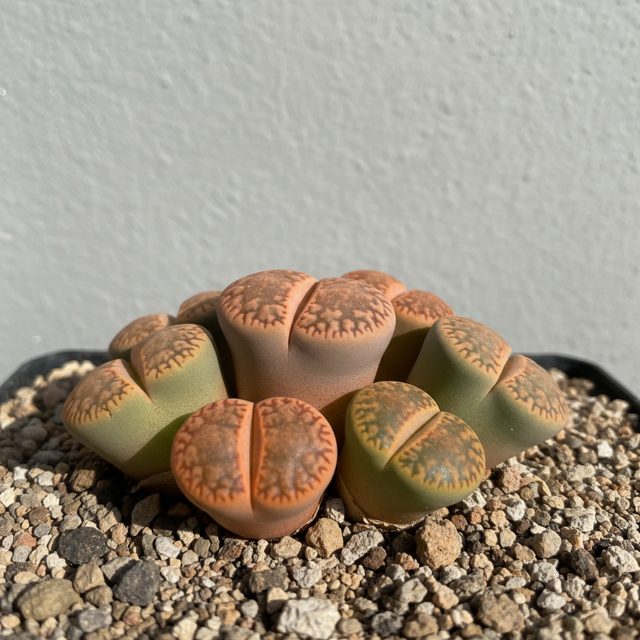
- Scientific name
- Lithops spp.
- Family
- Aizoaceae
- Also known as
- Living Stones, Flowering Stones
- Category
- Succulents & Cacti
- Care difficulty
- Hard
- Pet safety
- Non-toxic to cats and dogs
How to care for lithops
- Light: Requires very bright, direct sunlight for at least 4-5 hours daily. Etiolation will occur in insufficient light.
- Water: Watering is critical and highly seasonal; generally, water deeply but infrequently only when the plant is actively growing and the soil is completely dry. No water during dormancy or when splitting.
- Soil: Needs extremely well-draining, gritty soil mix with very little organic matter, such as pumice, perlite, and coarse sand. Good drainage is paramount.
- Temperature: Prefers warm to hot days (70-90°F / 21-32°C) and cool nights. Protect from frost.
- Humidity: Requires very low humidity. High humidity can lead to rot and fungal issues.
- Fertilizer: Rarely needs fertilizer. If growth is exceptionally poor, a very diluted, low-nitrogen succulent fertilizer can be applied once during the growing season.
- Propagation: Propagated by carefully dividing clumps of mature plants or from seeds. Seed propagation is a slow and delicate process.
Is lithops toxic to pets?
Pet-safe. Generally considered non-toxic to cats, dogs, and people, though ingestion of any plant material can cause mild stomach upset. See our guide to toxic plants for cats and dogs.
Common problems
- Rotting/mushy leaves: This is almost always due to overwatering; stop watering immediately and ensure extremely gritty, well-draining soil.
- Stretching/etiolation: Provide more intense direct sunlight; Lithops need very high light levels to maintain their compact form.
Did you know?
Lithops derive their name from the Greek words 'lithos' (stone) and 'ops' (face), perfectly describing their stone-like appearance.
Let PlantBetter help
Snap a photo with PlantBetter to confirm your plant is a lithops, spot problems early and get care reminders tailored to your home.