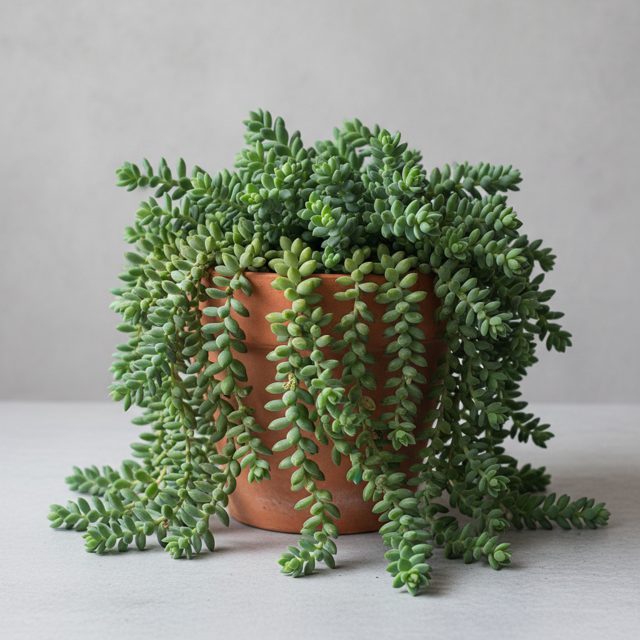
- Scientific name
- Sedum morganianum
- Family
- Crassulaceae
- Also known as
- Donkey's Tail, Lamb's Tail
- Category
- Succulents & Cacti
- Care difficulty
- Moderate
- Pet safety
- Non-toxic to cats and dogs
How to care for burro's tail
- Light: Requires bright, direct sunlight for at least 6 hours daily to maintain compact growth and vibrant color. Can tolerate some partial shade.
- Water: Water thoroughly when the soil is completely dry, typically every 2-4 weeks. Allow excess water to drain completely.
- Soil: Needs a very well-draining succulent or cactus potting mix. Add perlite or coarse sand for optimal drainage.
- Temperature: Thrives in average room temperatures of 65-75°F (18-24°C). Protect from frost, as temperatures below 40°F (4°C) can be damaging.
- Humidity: Tolerates average to low indoor humidity; does not require high humidity.
- Fertilizer: Fertilize sparingly, once or twice during the growing season (spring/summer) with a balanced liquid fertilizer diluted to half strength.
- Propagation: Easily propagated from stem cuttings or individual leaves. Allow cuttings/leaves to callus for a few days before placing on or in soil.
Is burro's tail toxic to pets?
Pet-safe. Non-toxic to cats, dogs, and humans. See our guide to toxic plants for cats and dogs.
Common problems
- Leaf drop when touched: Normal characteristic; handle carefully. Can also indicate extreme stress from underwatering or overwatering.
- Mushy, rotting stems: Caused by overwatering; ensure excellent drainage and allow soil to dry completely between waterings.
Did you know?
The leaves of Burro's Tail are incredibly fragile and detach easily, which is a natural propagation mechanism in their native habitat.
Let PlantBetter help
Snap a photo with PlantBetter to confirm your plant is a burro's tail, spot problems early and get care reminders tailored to your home.