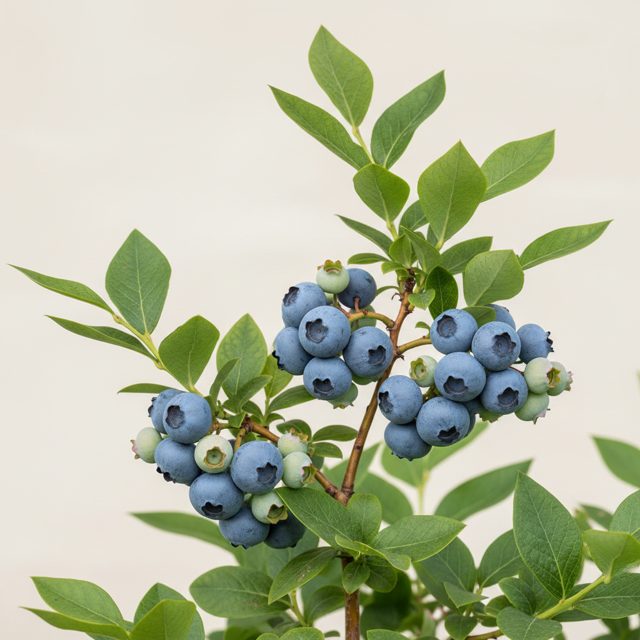
- Scientific name
- Vaccinium corymbosum
- Family
- Ericaceae
- Also known as
- Highbush Blueberry
- Category
- Vegetables, Fruits & Herbs
- Care difficulty
- Moderate
- Pet safety
- Non-toxic to cats and dogs
How to care for blueberry
- Light: Blueberry bushes need full sun, at least 6-8 hours of direct sunlight per day, for optimal fruit production.
- Water: Keep the soil consistently moist; blueberries have shallow roots and are sensitive to drought.
- Soil: They require highly acidic, well-draining soil with a pH between 4.5 and 5.5, rich in organic matter.
- Temperature: Blueberries are cold-hardy but require specific chill hours in winter to produce fruit.
- Humidity: They prefer moderate to high humidity.
- Fertilizer: Use an acid-forming fertilizer formulated for blueberries or azaleas in early spring and late spring.
- Propagation: Blueberries can be propagated by softwood or hardwood cuttings, taken in late spring or late fall/winter, respectively.
Is blueberry toxic to pets?
Pet-safe. Blueberries are non-toxic to cats, dogs, and humans. See our guide to toxic plants for cats and dogs.
Common problems
- Lack of fruit: Ensure sufficient chill hours for the variety, correct acidic soil pH, and adequate sunlight.
- Yellowing leaves (chlorosis): This often indicates high pH soil; amend soil with sulfur or use acidifying fertilizers.
Did you know?
Blueberries are one of the few fruits native to North America.
Let PlantBetter help
Snap a photo with PlantBetter to confirm your plant is a blueberry, spot problems early and get care reminders tailored to your home.